Voyage autour de ma chambre par M. le Chev. X*** ***
FULL DESCRIPTION & PRICE: Voyage autour de ma chambre
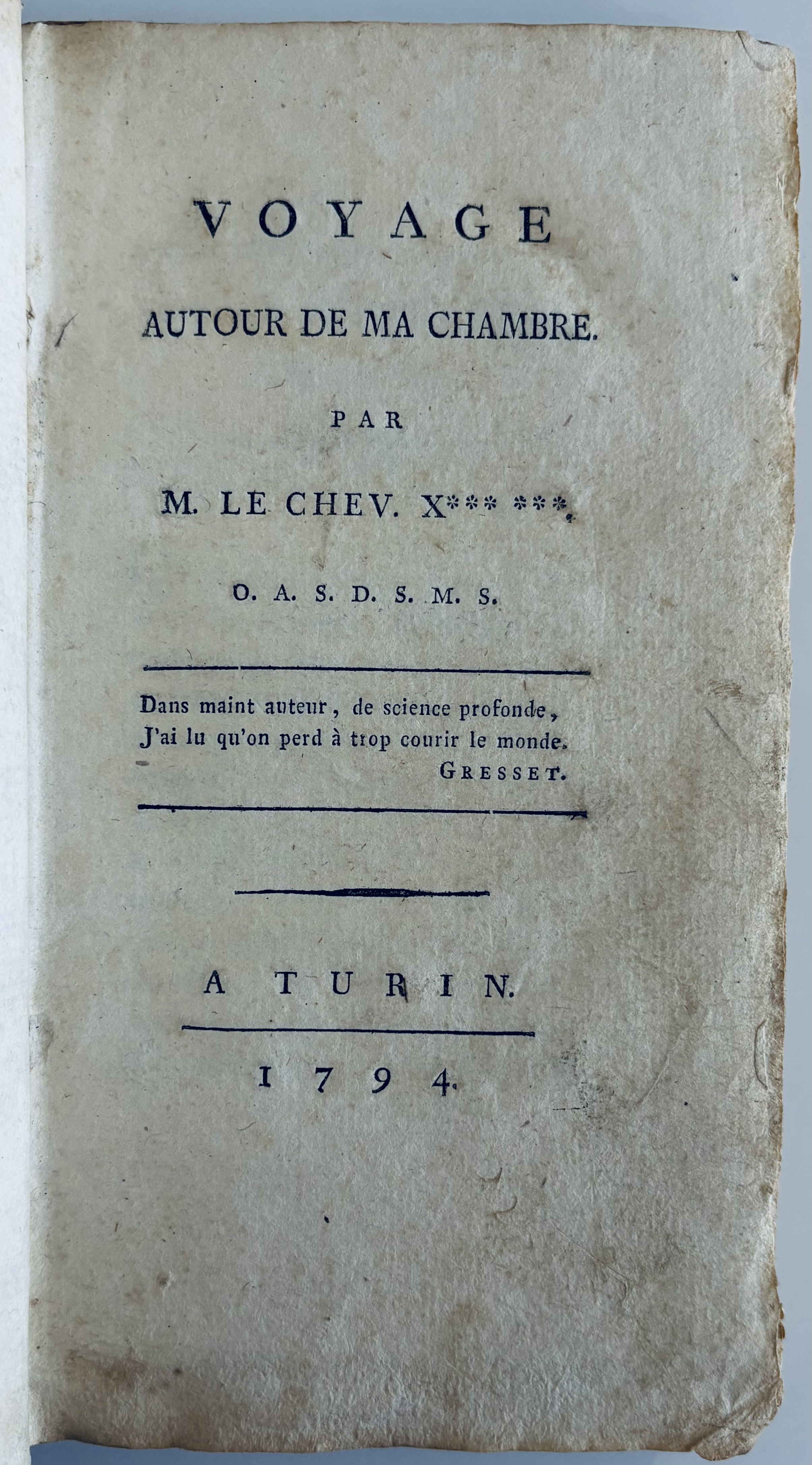
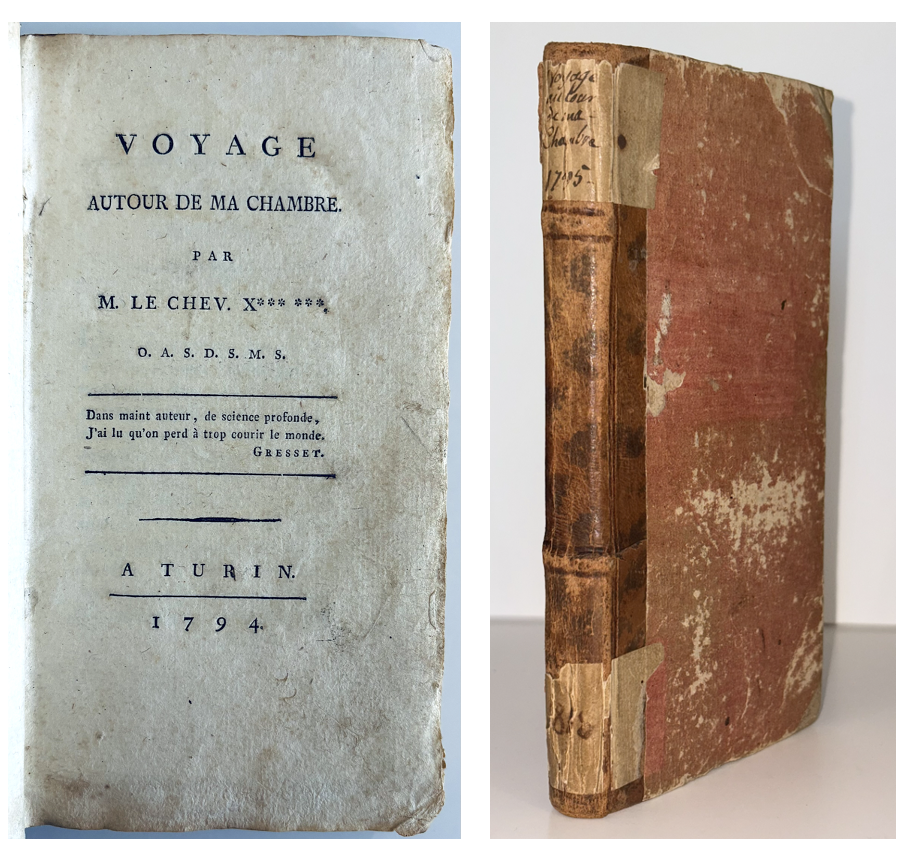
Published by Turin, 1794 [Lausanne, Isaac Hignou, 1795]. First edition.
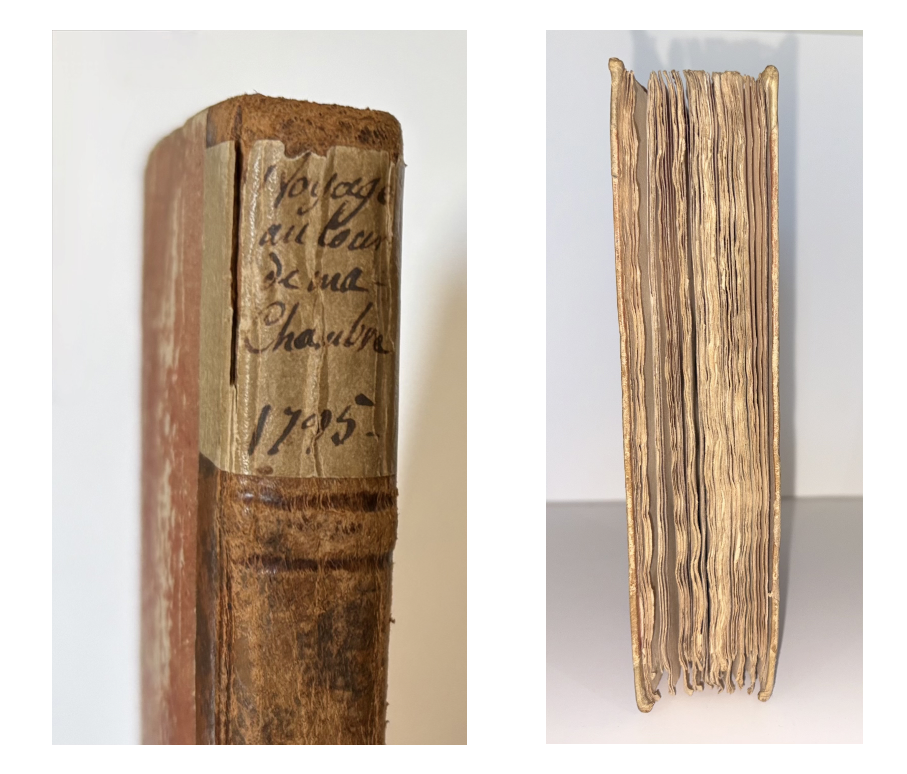
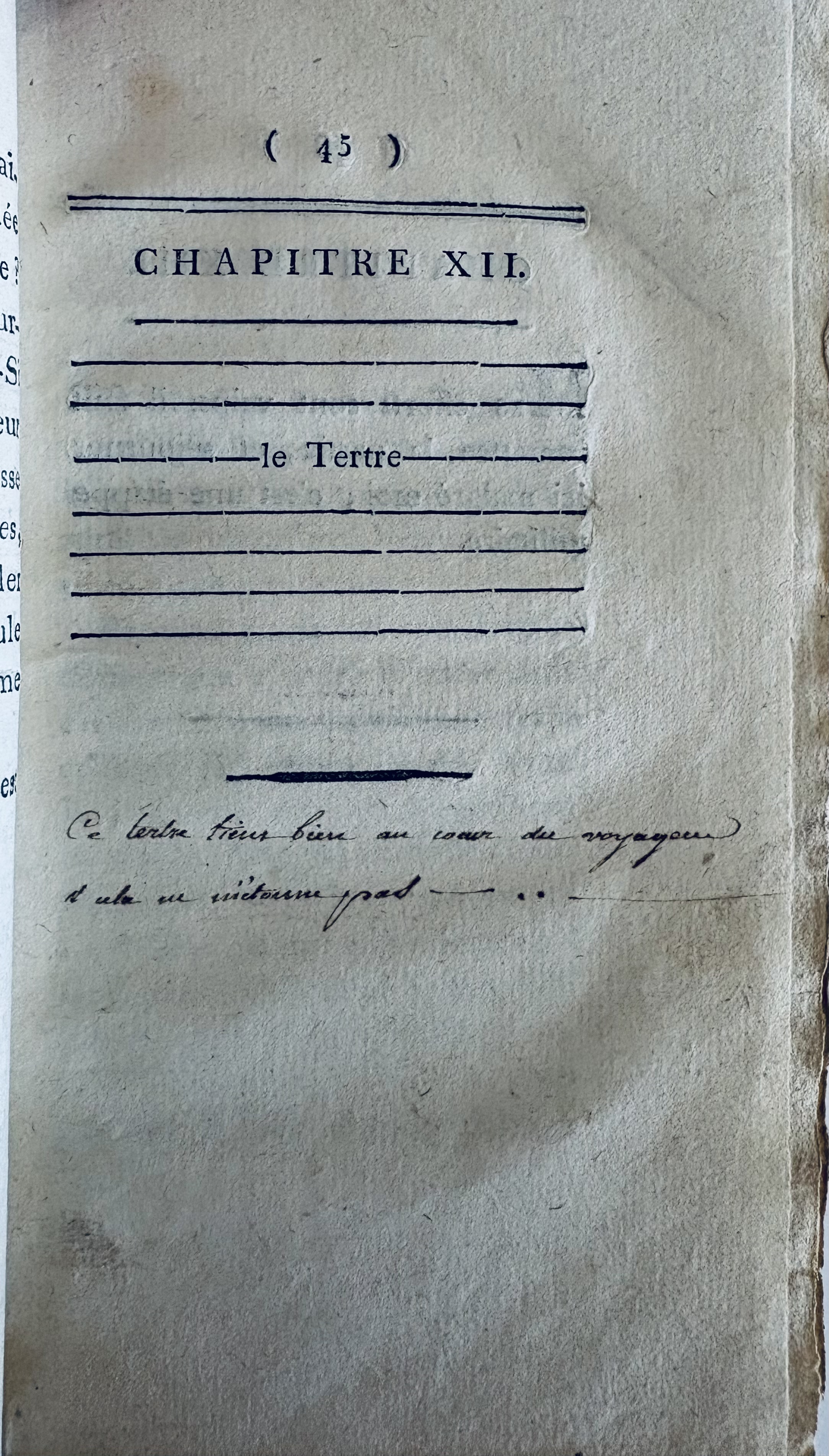
12°: A-H12 [$6 (-A1) signed]; [1-2] 3-188, [4] pp. Contemporary sheep spine and vellum corners, paper covered boards with paper labels at the head and foot for the title and shelf mark. Untrimmed and utterly contemporary, boards rubbed but a solid volume, with fresh leaves– a stunning copy of an exceedingly rare title.
The Grand Tour reduced to a single room:
Voyage autour de ma chambre was published without the author’s knowledge, under the false imprint of “Turin, 1794”—a ruse carried out by the author’s brother, the philosopher Joseph de Maistre, who had it printed in Lausanne, 1795. This work of 42 short chapters was written while Xavier de Maistre was under house arrest in Turin for dueling—one chapter for each day of confinement. The book parodies the contemporary travel genre and the Grand Tour: de Maistre’s “voyage” is conducted as an ironic travelog around his room, in which he describes his furnishings and the other individual objects around him with the care of an archeologist examining the ruins at Pompeii in a humorous, yet erudite manner.
An important imaginary travelogue and a new genre:
As the Romantic critic Charles Nodier observed, de Maistre’s Voyage is an important early example of the imaginary travelog, along with Laurence Sterne’s A Sentimental Journey Through France and Italy (1768), which inspired many followers, including Bellin de la Liborlière’s Voyage dans le boudoir de Pauline, and others like Voyage de vingt-quatre heures, Voyage au palais royal, Voyage dans mes poches, etc. These latter works typically follow the ironic or satirical mode of their predecessors, and move away from the Sentimental Novel, which is at times parodied, toward the Romanticism of the late 18th and early 19th century. The prescience and originality of de Maistre’s work allow modern readers to compare it to Marcel Proust's single (cork-lined) room, which facilitated the writing of A La Recherche de Temps Perdu (1913-1927), as well as Georges Perec's Espèces d'Espaces (1974), a work that examines rooms and spaces in a topographical manner.
Xavier de Maistre (1763-1852) was an author and a military officer, and the younger brother of the philosopher Joseph de Maistre (1753-1821). Xavier was a dedicated counter-revolutionary and defied the rule of Napoleon I by refusing to swear allegiance to him, eventually joining the Russian army where he attained the rank of a General. He eventually resided in Saint Petersburg until his death. Voyage autour de ma chambre is his best-known work.